
New York Has Never Been More Connected. So Why Does It Feel So Lonely? Our Guide to Making Friends in New York City!
Written by Layla Wall
There is a daunting loneliness that New York produces. You leave work surrounded by thousands of people. The subway platform is packed. Restaurants spill onto sidewalks. Friends laugh over drinks in the East Village while runners weave through Central Park and couples gather on blankets in Prospect Park.
Everywhere you look, people seem to be living full, connected lives. Making Friends in New York City
By the time you get home, you realize you haven't had a real conversation with anyone who actually knows you. In a city of more than eight million people, loneliness shouldn't make sense. Yet ask almost anyone who's moved to New York, whether six months ago or six years ago, and you'll likely hear the same confession. Meeting people is easy. Building a community is something else entirely.

For many New Yorkers, loneliness doesn't come from being physically alone. It comes from existing in constant proximity to other people without ever quite feeling connected to them. You can spend an entire day around strangers, answer Slack messages from coworkers, scroll Instagram for hours, and still realize nobody has asked how you're really doing all week. Making Friends in New York City
The truth is, this isn't just a New York problem. Remote work, rising housing costs, longer commutes, and increasingly digital lives have changed how people build relationships everywhere. But New York magnifies the contradiction. It's one of the busiest, loudest, and most stimulating places on earth, making the absence of genuine connection feel even more noticeable. The encouraging part is that people haven't stopped looking for community. They're simply finding it in new ways.
The Return of the Third SpaceMaking Friends in New York City
Most friendships don't begin because we decide we need more friends. They begin because we keep ending up in the same place. Sociologists call these places "third spaces", the environment that exists somewhere between home and work. Coffee shops, bookstores, volunteer organizations, neighborhood events, community gardens, recreation leagues, and clubs where people return often enough for familiarity to become friendship.
For decades, these spaces quietly formed the backbone of community life. Many have disappeared. Others have become prohibitively expensive. Remote work removed countless casual interactions that once happened naturally. Increasingly, building a social life requires intention. Ironically, some of the technology often blamed for making us feel disconnected is helping people find those spaces again. Rather than replacing real-world relationships, these platforms have become modern bulletin boards, helping people discover where community is already happening.
PLATFORMS TO CONNECTMaking Friends in New York City
LumaMaking Friends in New York City
If you've spent time around New York's creative, nonprofit, startup, or cultural communities, chances are you've received a Luma invitation. Open the platform on any given evening and you'll find everything from climate discussions and founder meetups to writing workshops, community dinners, philosophy salons, pottery classes, neighborhood walks, and artist talks. What makes Luma so effective isn't necessarily the events themselves. It's the people who attend them. Everyone has already made the same decision: they're showing up because they want to meet people. That shared openness removes much of the awkwardness that usually comes with introducing yourself to strangers.
Partiful
Originally designed to organize parties, Partiful has become one of the easiest ways New Yorkers gather for birthdays, dinner parties, rooftop hangs, picnics, and neighborhood events. Its biggest strength is that it reminds us not every social interaction needs to be networking. Sometimes the best way to meet people is simply showing up for something fun.
Timeleft
With Timeleft, small groups of strangers are matched for dinner each week based on a short personality questionnaire. It sounds intimidating until you realize everyone sitting around the table signed up for exactly the same reason. They're looking for a connection.
Parlor Social Club
Not every community starts with an app. Across New York, a growing number of membership-based social clubs are reimagining what a third space can look like, and one of the more interesting examples is Parlor Social Club. Rather than centering around nightlife or traditional networking, Parlor is built around shared experiences. Members might find themselves at intimate dinners, cultural conversations, wellness events, creative workshops, or neighborhood gatherings designed to encourage people to linger rather than simply attend. Whether through a membership community, a volunteer organization, or a local run club, the principle is the same: people are far more likely to become friends when they have a reason to keep crossing paths.Making Friends in New York City
What People Get Wrong About Making Friends in New York
One piece of advice gets repeated constantly: put yourself out there. It's well-intentioned, but it's also frustratingly vague. Most New Yorkers are already doing exactly that. They're saying yes to invitations. Signing up for classes. Going to networking events. Joining clubs. Attending concerts. The problem usually isn't meeting people. It's seeing them again.
Friendship is rarely built through one extraordinary conversation. More often, it's the product of ordinary repetition. You recognize someone from last week's volunteer shift. You end up sitting beside them again at the monthly book club. A quick hello becomes a longer conversation. Eventually, someone suggests grabbing coffee afterward. Almost without noticing, familiarity becomes trust.
The people who seem to have thriving communities aren't necessarily the most outgoing. More often, they're the ones who keep returning. The same volunteer shift. The same community dinner. The same climbing gym. The same neighborhood café. The same Wednesday night trivia team. Community is less about finding the perfect event than it is about becoming a familiar face.
PLACES TO CONNECTMaking Friends in New York City
Learn with Others at Spray Painting 101 with Bianca Romero
NYC muralist Bianca Romero is bringing her signature street-art style to Time Out Market Union Square (124 East 14th St.) for a Spray Painting 101 class series on September 13th, 20th and 27th. Over the course of 3 classes, students will learn the basics and tricks of spray painting, build their skills and create their own NYC-inspired artwork to take home. The ticket cost includes a personal canvas, spray paint, and materials as well as instruction from a professional artist. Each class also includes a happy hour drink, making it a fun, creative way to spend an afternoon and meet new friends.
Find more information and buy tickets HERE.

Catch the Games at Time Out Market Union Square
Kick your weekend off with Pregame Saturdays and Tailgate Sundays at Time Out Market Union Square! From 7 PM to 11 PM on Saturdays and 12 PM to 9 PM on Sundays, this weekly party will bring together all-day happy hour food from Time Out Market’s diverse vendors, and live sets from some of NYC’s hottest DJs for a high-energy evening. Whether you’re meeting up with friends or meeting new ones, be prepared to grab a bite, a sip and relish in this lively weekend destination,
Explore Wine Pairings Over Dinner at Le Petit Village in the West Village
Spend an evening at Le Petit Village in the heart of the West Village during a special Wine Tasting Dinner on Wednesday, September 16th. The menu will honor the flavors of the South of France over five courses. Each late-summer dish will be thoughtfully paired with a wine selected by WSET Level 3 sommelier Josh Lepre, taking visitors on a gastronomic adventure centered around great food, wine, and foodies gathering around one table. The experience begins at 6:30 PM.
Reservations are available on RESY.

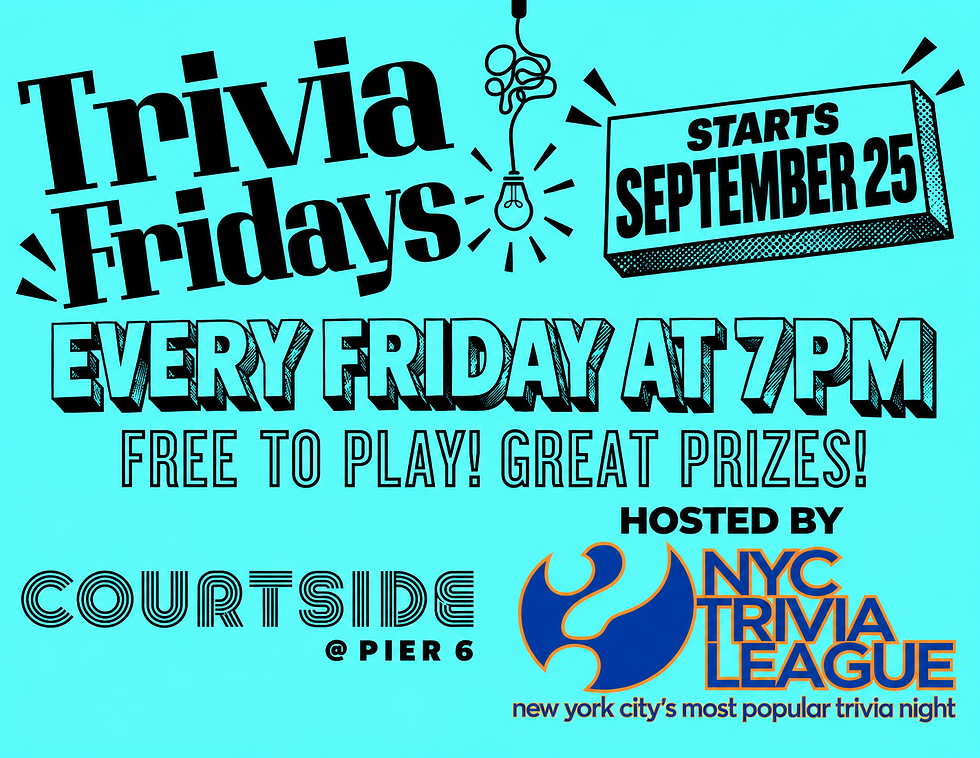
Weekly Trivia Fridays Debut at Fornino in Brooklyn Bridge Park, Pier 6
Enjoy a perfect Friday night at Fornino in Brooklyn Bridge Park, Pier 6 with sunset views, wood-fired antipasti or Neapolitan pizzas, and free trivia! Start the evening with a pie atop Fornino's seasonal rooftop, where you can marvel at the waterfront. Then head downstairs to Courtside at Pier 6 for the launch of Weekly Trivia Fridays, presented by NYC Trivia League, beginning at 7pm. Trivia is free to play, with teams answering questions digitally from their phones and great prizes up for grabs. The first weekly trivia event will take place on Friday, September 25th.
Find more information HERE.
Explore Grand Bazaar NYC at Hudson Square
Shop and socialize at Grand Bazaar NYC during their pop-up at Hudson Square Plaza at 155 Avenue of the Americas this Fall. This special limited-time activation running from September 16th through October 7th will take place every Wednesday from September 16th through October 7th from 11am-6pm, bringing a curated selection of the market’s standout vendors, makers, and items to a new downtown setting. Chat with vendors about these extraordinary collections while you explore an eclectic mix of fashion, vintage finds, art, accessories, home goods, and other one-of-a-kind treasures. The Hudson Square activation offers a chance to experience what has made Grand Bazaar NYC a beloved Upper West Side institution for more than 40 years and championed independent makers, sustainable style, and community.
Find more information HERE.

Taste of Sunnyside Returns to Queens
Taste of Sunnyside will return to Queens on October 4th for its 16th annual celebration of the neighborhood’s vibrant culinary scene. Presented by the Sunnyside Shines Business Improvement District, the community festival will bring together local food, live music, family-friendly activities, and other entertainment throughout the neighborhood, giving attendees the opportunity to discover and sample offerings from Sunnyside’s diverse dining scene while enjoying a festive afternoon with friends and family.
Find more information HERE.

A City Full of People Looking for the Same Thing
Perhaps the greatest irony is that loneliness is often invisible. Everyone assumes they're the only person arriving alone, the only one wondering if they'll fit in, the only one quietly hoping someone starts a conversation. Meanwhile, many of the people standing beside them are carrying the exact same thought. Spend enough time talking to New Yorkers, and the conversation almost always circles back to the same themes. Making friends as an adult is difficult. Building community takes time. People want deeper relationships than the ones they're finding online. Everyone assumes everyone else has already figured it out, when in reality, most people are still searching. So, Where Do You Start?
The advice isn't particularly glamorous. Choose one thing and keep showing up. Not ten different things. One. Join a discussion group. Volunteer once a month. Attend the same community dinner. Become a regular at your neighborhood coffee shop. Sign up for a weekly pottery class. Go back to the same run club even if the first visit feels awkward. The activity itself matters far less than consistency. Community rarely arrives in one life-changing moment. It grows quietly through shared experiences, familiar faces, and conversations that become a little longer each time.
New York has always been a city people come to in search of something—opportunity, ambition, reinvention, adventure. Increasingly, many are arriving in search of community. The encouraging part is that the desire for connection never disappeared. If anything, people seem more willing than ever to admit they want it. The technology helping New Yorkers find one another isn't replacing real life. It's simply making introductions. The friendships still happen over dinner, after volunteer shifts, during neighborhood walks, in bookshops, at neighborhood events, and in cafés where the barista eventually learns your name. In a city famous for moving fast, belonging is still built slowly. One familiar face at a time.


Comments